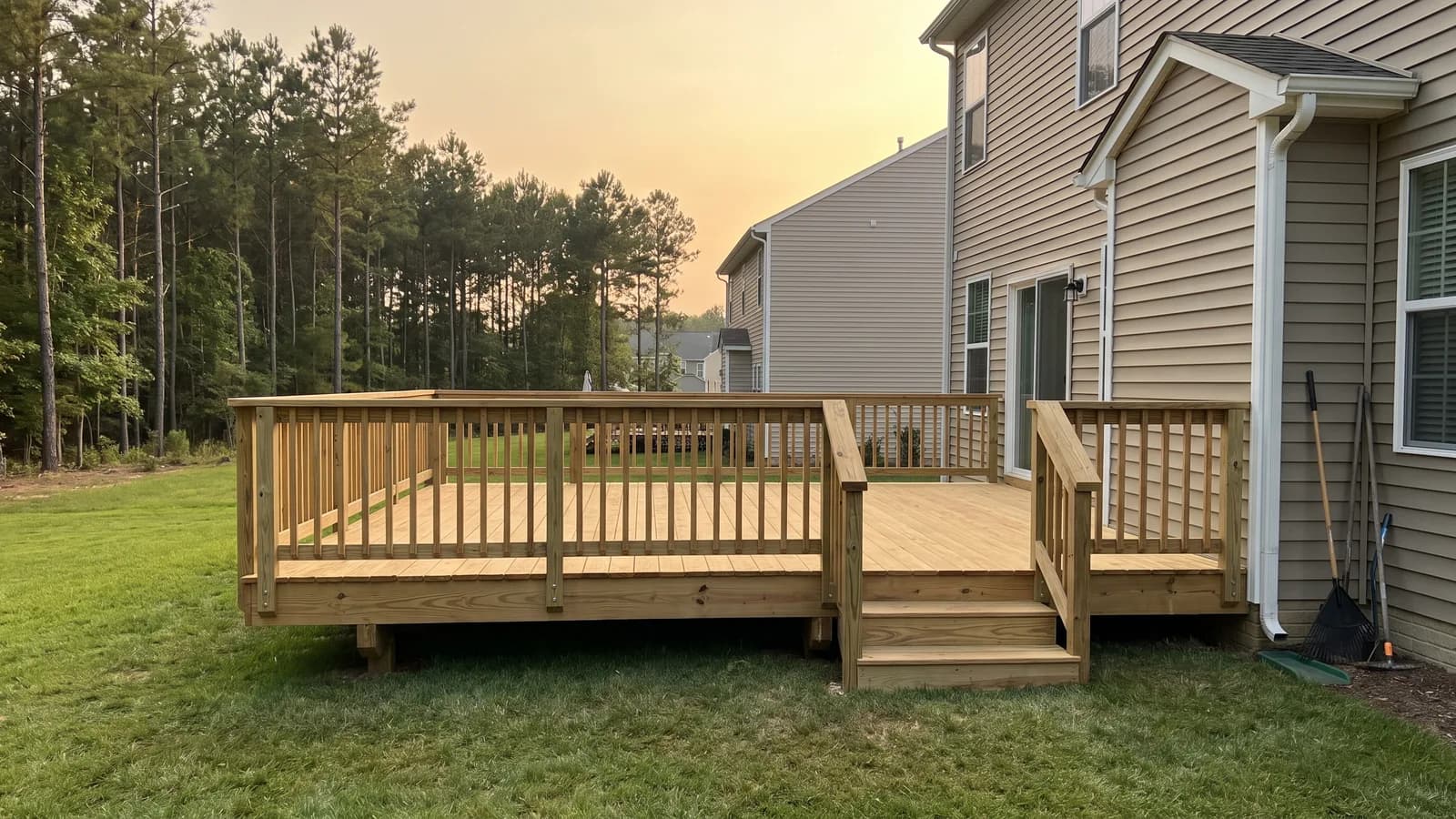
Most Georgia jurisdictions require a building permit for a residential deck, and the size and height thresholds homeowners repeat to each other are not Georgia rules. Georgia adopts the International Residential Code but deletes the chapter listing work exempt from permits, so there is no statewide deck exemption to rely on. What Georgia does have is its own amendments to the deck construction section, and they land on the connection that causes deck collapses.
Key takeaways
-
Georgia deletes Chapter 1 of the residential code without substitution, so the commonly quoted deck size and height exemptions are not statewide Georgia law.
-
Georgia amends the deck section directly, revising the ledger to band joist fastening details and the deck attachment figures for lateral loads.
-
The ledger connection is where a deck fails, and it is the detail Georgia chose to write its own text for.
-
A deck usually needs zoning approval as well as a building permit, because it counts against setbacks and lot coverage in most local ordinances.
Do I need a permit to build a deck in Georgia?
Assume yes and confirm with the office that covers your address. The Georgia state amendments to the International Residential Code instruct users to "Delete Chapter 1 'Scope and Administration' without substitution," leaving it in the book only as a reference for local governments writing their own administrative procedures. Chapter 1 is where the model code puts permits, exempt work and required inspections.
That deletion is why two neighboring counties can treat the same deck differently. Under O.C.G.A. 8-2-25 the state minimum standard codes apply statewide without local adoption, but a municipality or county is only "authorized to enforce" them. Construction standards are statewide. Permit administration is not.
Is there a size or height exemption for decks in Georgia?
Not at the state level. The thresholds people repeat, a deck under a certain square footage, or below a certain height above grade, or not attached to the house, all come from the model code chapter Georgia deleted. Quoting them as Georgia law is the same mistake as quoting the model code's shed exemption, which is the correction at the center of the Georgia shed permit guide.
Some jurisdictions have adopted similar thresholds in their own procedures, which is why the numbers keep circulating and sometimes turn out to be right. They are local, so confirm yours in writing, and ask separately about zoning: a deck can be exempt from a building permit and still need zoning approval.
What did Georgia change in the deck code?
Georgia writes its own text into the exterior decks section rather than accepting the model version. The amendment packet revises the deck beam to deck post figure to add a corner beam over post illustration, revises the ledger to band joist details, revises the figures showing placement of lag screws and bolts in band joists both with and without cladding, and revises both deck attachment figures for lateral loads, all effective January 1, 2026.
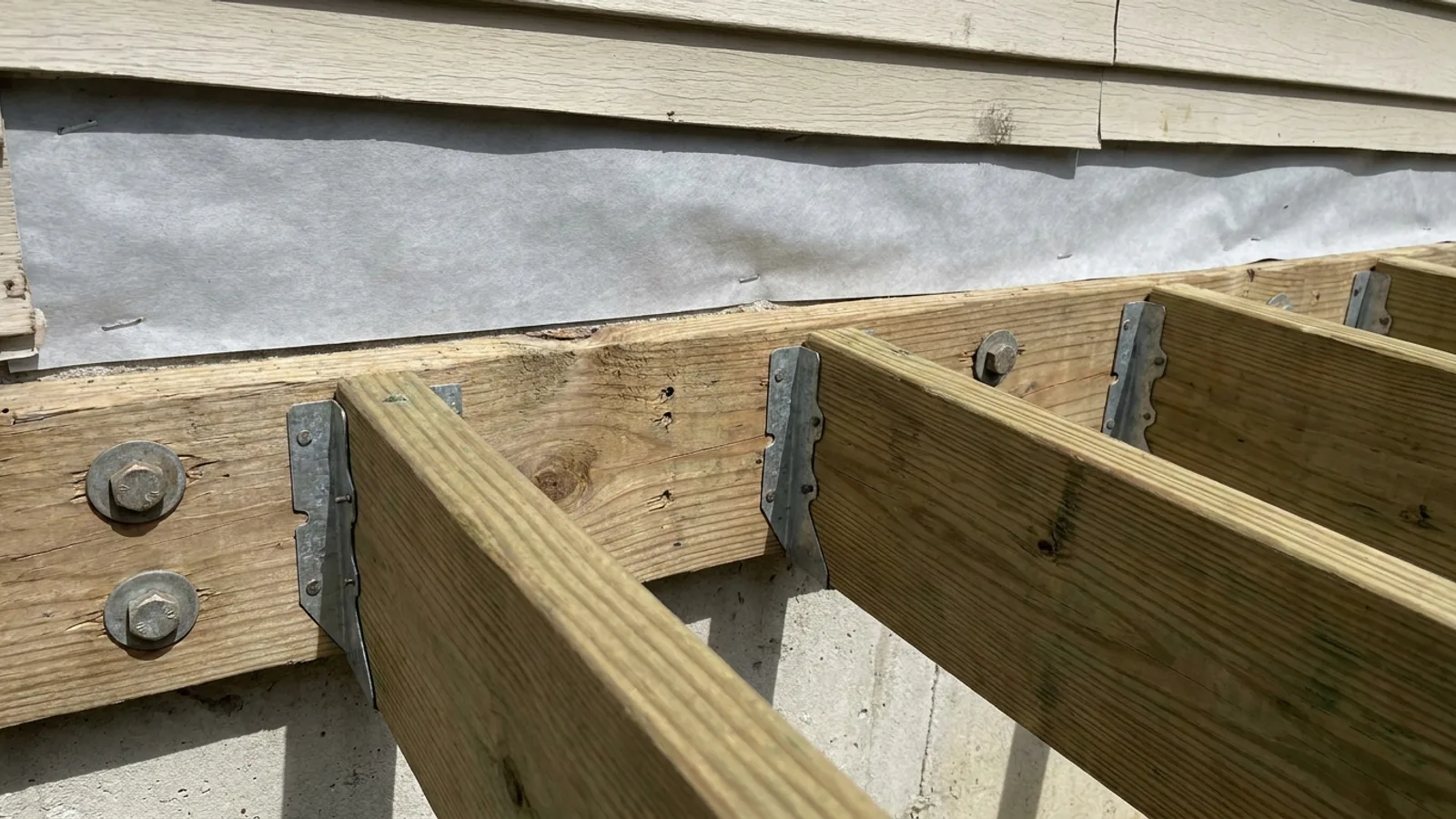
The ledger revision is the most specific. Georgia requires that holes for half inch lag screws be predrilled with two drill bits, so a half inch diameter hole goes through the ledger and the sheathing if present, and a smaller hole between five sixteenths and three eighths of an inch goes through the band joist. That is a detail an inspector can check and a builder can get wrong, and it exists because the fastener has to bite the band joist rather than spin in an oversized hole.
Why does the ledger connection matter so much?
Because it is the connection that fails. A deck ledger carries the deck's load into the house's band joist through fasteners in a joint hidden behind decking and often behind cladding. Deck collapses are overwhelmingly connection failures rather than broken lumber, which is why the code devotes tables and figures to fastener type, size, spacing and placement, and why Georgia amended those figures rather than the framing spans. Lateral load attachment is the related item, and the figures Georgia revised address holding the deck against the house under lateral force, a separate problem from holding it up. If your builder cannot explain how both are achieved, have that conversation before the framing is covered.
Does a freestanding deck avoid all of this?
It avoids the ledger, not the permit. A freestanding deck carries its own load on its own posts and footings, with no structural connection to the house. Builders sometimes propose it precisely because the ledger condition on an older house is unknown.
What it does not do is exempt the structure. Footings, post sizing, spans, guards and stairs are all still code work, and the zoning question is unchanged. Treat freestanding as a structural decision, not a permitting shortcut.

Where can a deck legally sit on my lot?
Wherever your local zoning ordinance allows, which is a separate question from the building code and often the one that stops a project. Setbacks, lot coverage and easements are local rules, and in most Georgia ordinances a deck counts as structure for at least some of them.
Resolve this before anything is designed, because a deck built into a setback cannot be fixed by inspection. The remedy is a discretionary variance or moving the structure. The Georgia setbacks and zoning guide covers how the two approvals interact.
What inspections does a deck need?
Typically footings before concrete, framing before decking and cladding conceal the connections, and a final. The exact list is local.
| Stage | What is being confirmed | Do not cover it before |
|---|---|---|
| Footing | Size, depth, bearing, location relative to setbacks | Concrete is poured |
| Framing | Ledger fastening, lateral attachment, beam and joist sizing, post connections | Decking or cladding goes on |
| Final | Guards, handrails, stair rise and run, stair stringers, landings | Occupancy or use |
What a Georgia inspector checks covers those stages, and the inspection order guide explains why covering the ledger early is the expensive mistake.
Our take: the ledger and the setback are the two things worth being difficult about. Everything else on a deck can be corrected later at ordinary cost. A concealed ledger connection and a structure sitting three feet into a setback are both fixed by demolition, and both are avoidable with one phone call before the build starts.
What should I ask before hiring a deck builder?
Ask whether the deck will be attached or freestanding, and how the lateral attachment is made. Ask how the ledger fasteners are being installed, including predrilling, and whether the band joist condition has been inspected. Ask who is pulling the permit, and confirm it is being pulled. Ask what the setback is on your rear and side lot lines and how close the design comes to it.
Then run the free permit checker for your county, and check the details for your Georgia county. If the deck is part of a larger project, the addition and alteration project page covers how scope changes the review.