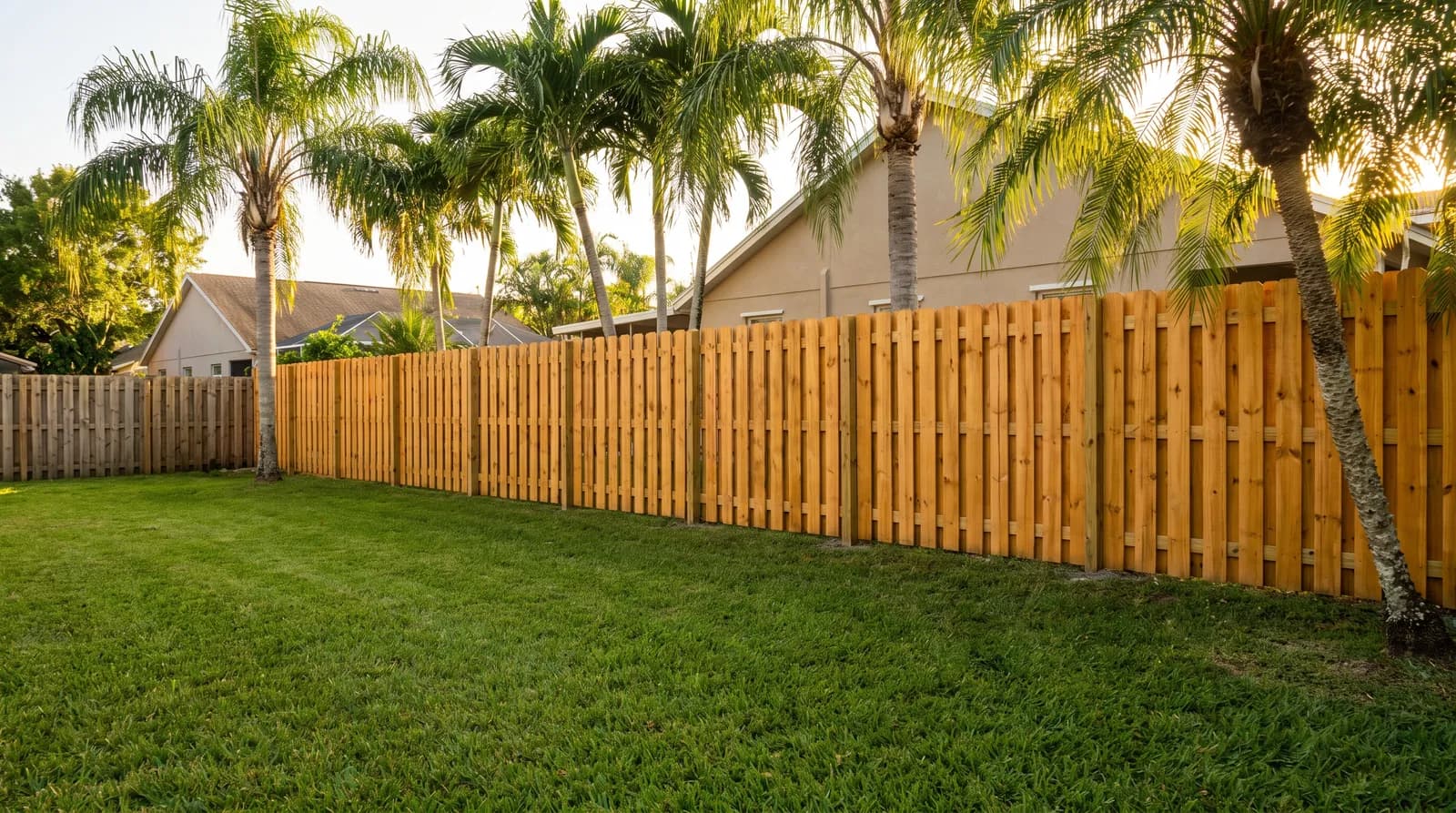
Whether you need a fence permit in Florida depends entirely on where you live. There is no single statewide fence permit rule. Height limits, setbacks, corner sight triangles, and whether a permit is required at all are set by each city and county, and they vary a lot even between neighboring jurisdictions. In many Florida jurisdictions a residential fence permit is required, and where it is not, zoning rules on height and placement usually still apply. This guide explains how fence height, setbacks, and sight triangles generally work, and how to confirm the exact rule for your address before you dig a post hole.
Key takeaways
- There is no statewide Florida fence permit rule. Requirements are set by your city or county, so you must confirm locally.
- Many Florida jurisdictions require a permit for a new fence, and a property survey is commonly part of the application.
- Height limits commonly differ by yard: lower in the front yard and taller in the side and rear yards, but the exact figures vary by jurisdiction.
- Corner lots must keep the fence out of the sight triangle (clear-view triangle) at the intersection so drivers can see.
- Even where no permit is required, zoning rules on height, setbacks, and materials still apply, and your HOA may have its own approval.
In this guide
- Do you need a permit for a fence in Florida?
- Why is there no single statewide fence rule?
- How tall can a fence be in Florida?
- What are fence setbacks and property lines?
- What is a corner sight triangle?
- Do the rules differ by front, side, and rear yard?
- What do Orange County fence rules look like?
- What do Polk County fence rules look like?
- Does HB 803 exempt fences from a permit?
- Does your HOA also have to approve the fence?
- Worked example: a 6-foot fence on an Orange County corner lot
- How do you get a fence permit in Florida?
Do you need a permit for a fence in Florida?
Often yes, but it depends on your jurisdiction. Many Florida cities and counties require a permit to install a new fence, and some also require one for fence repair or replacement, while others exempt certain fence types or heights. Because the requirement is local, the only reliable answer comes from your own city or county building or zoning department.
The safe approach is to assume a permit may be required and confirm before you build. A fast way to check is our free permit checker, which points you toward the requirement for your project and location. You can also see what a fence project typically involves on our fence installation page before you start.
Why is there no single statewide fence rule?
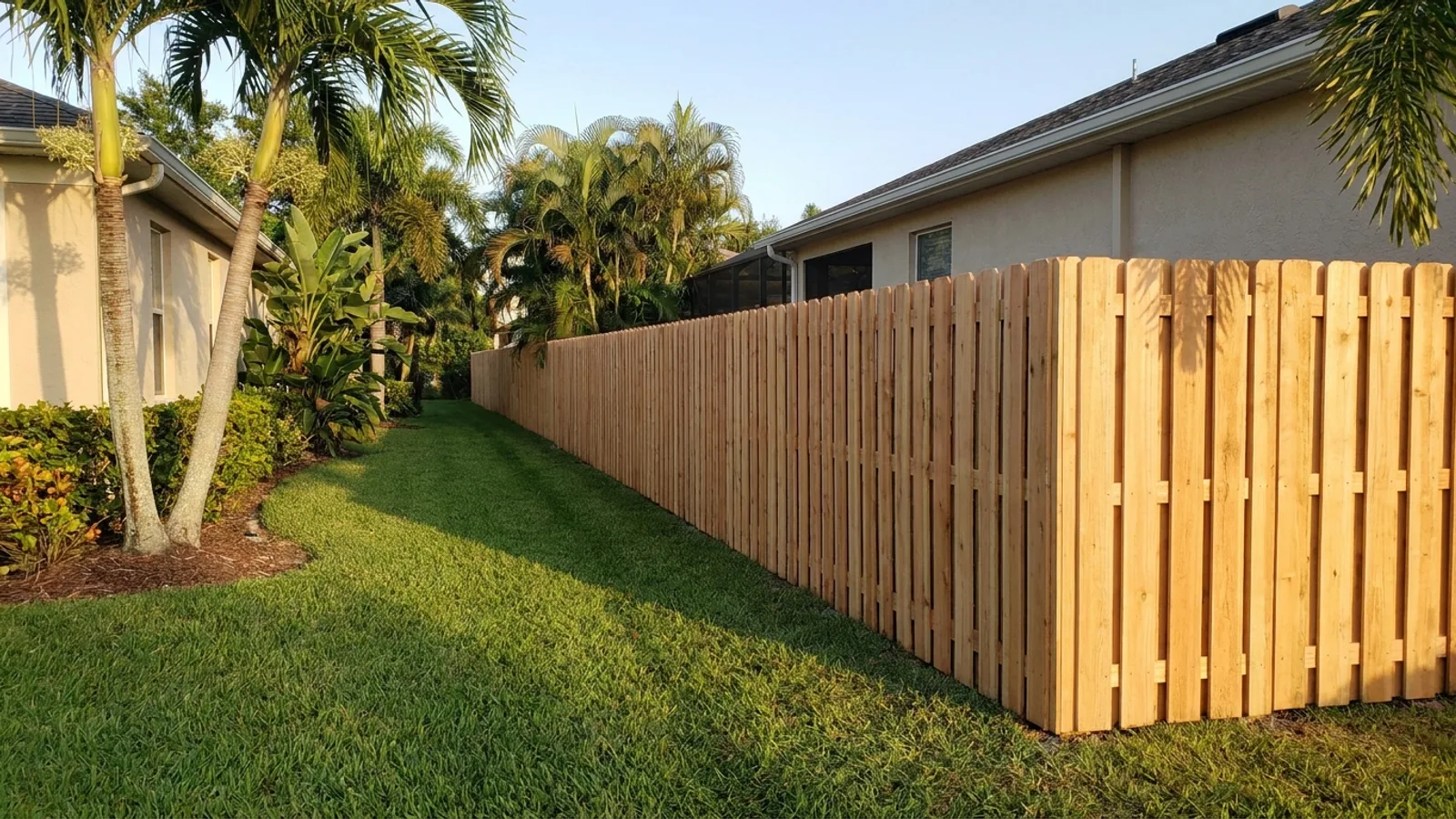
Florida regulates fences at the local level, through city and county zoning codes, not through one statewide fence statute. That means height limits, setbacks, sight-triangle rules, permit requirements, and even allowed materials are written into local ordinances, and they differ from one jurisdiction to the next.
This is why generic online fence advice is risky in Florida. A height limit that is correct in one city can be wrong one street over in an unincorporated county area. Any specific number you read, including in this guide, should be treated as a common pattern to verify against your local code, not as a statewide rule.
How tall can a fence be in Florida?
Maximum fence height is set locally and commonly depends on which yard the fence is in. A frequent pattern in Florida jurisdictions is a lower limit in the front yard and a taller limit in the side and rear yards, but the exact heights vary by city and county. Some jurisdictions also cap height near lakes, canals, or major roadways.
Because the number is local, do not assume a height that is legal elsewhere is legal for you. If you want a tall privacy fence, confirm the maximum for your specific yard and zoning district first. Exceeding the local limit can mean a permit denial, a required variance, or an order to take the fence down.
What are fence setbacks and property lines?
A setback is how far a structure, including a fence in some cases, must sit from a property line, right-of-way, or feature like a lake. Many jurisdictions allow fences close to or on the property line in side and rear yards, but restrict how close and how tall they can be near the front and near street rights-of-way.
This is why a current survey matters so much for fences. Building your fence based on where you think the line is, rather than where the survey shows it, is how neighbors end up in boundary disputes and homeowners end up moving a finished fence. Most building departments that permit fences ask for a survey showing the proposed fence location for exactly this reason.
What is a corner sight triangle?
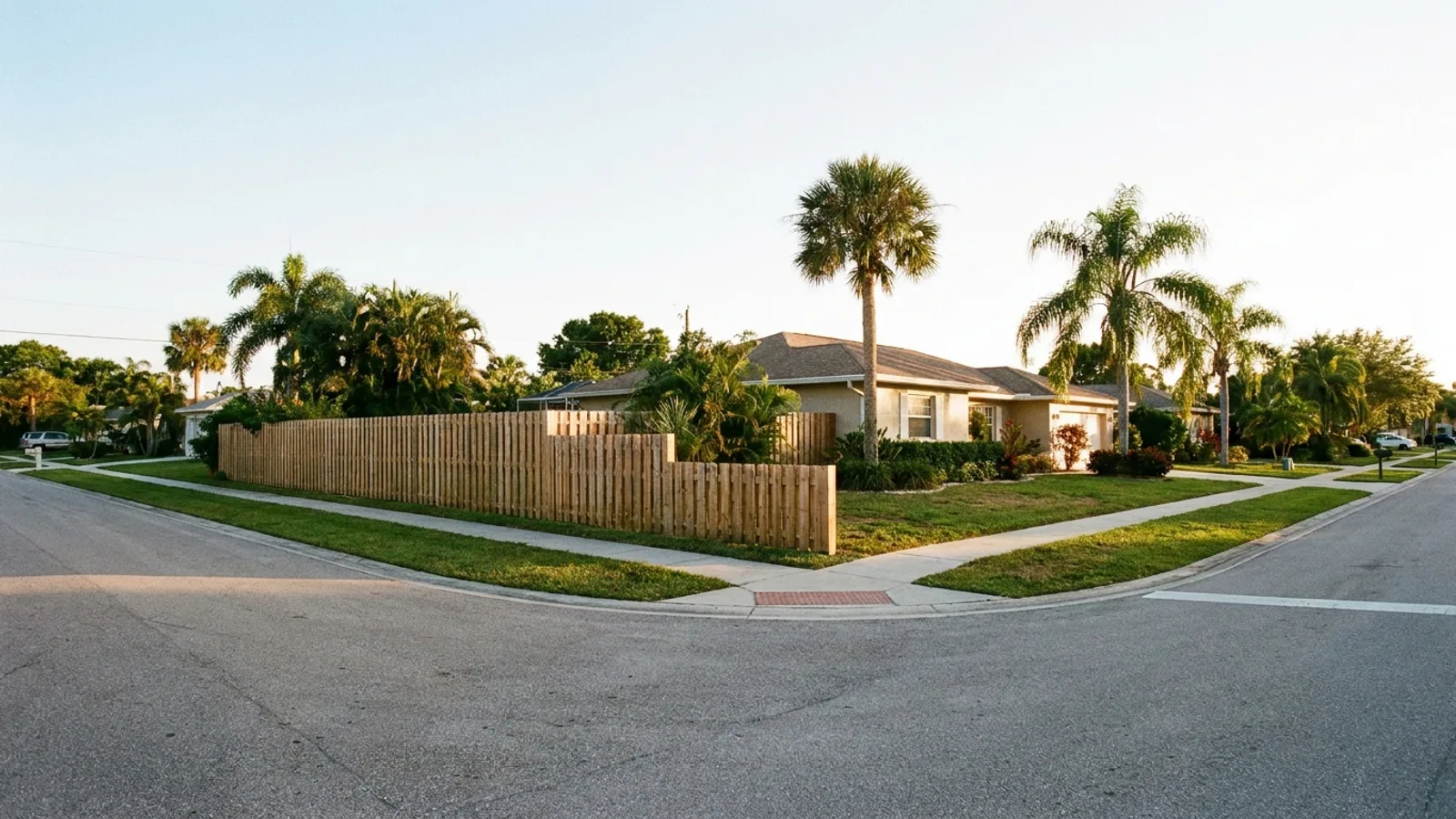
A sight triangle, also called a clear-view or corner-visibility triangle, is the area near a street intersection or driveway that must stay clear enough for drivers to see. Within that triangle, jurisdictions restrict fence height so a solid fence does not block the view of oncoming traffic. It is one of the most commonly overlooked fence rules on corner lots.
The triangle is typically measured from the corner where two streets meet, extending a set distance along each street line, with the fence height limited inside that zone. The exact dimensions and height limit are set locally. If you are on a corner lot or near a driveway, ask your jurisdiction specifically about the sight-triangle requirement before you place the fence.
Do the rules differ by front, side, and rear yard?
Yes. Fence height and placement rules commonly differ depending on which yard the fence is in, with the front yard usually the most restricted. The table below shows the general pattern seen across many Florida jurisdictions. Treat it as a starting framework, not as your local rule, and confirm the actual figures with your city or county.
| Location | Common pattern | What to confirm locally |
|---|---|---|
| Front yard | Lower height limit, more restricted | The exact maximum height allowed |
| Side yard | Taller height often allowed | The maximum height and any setback |
| Rear yard | Taller height often allowed | The maximum height and rear setback |
| Corner lot near intersection | Height limited in the sight triangle | Triangle size and height cap |
| Near a lake, canal, or major road | Sometimes a lower height cap | Whether a special limit applies |
What do Orange County fence rules look like?
Orange County regulates residential fences through its zoning code and requires a permit for fence installation, with a survey showing the fence location. Under the county's fence and wall regulations, residential fences are commonly limited to a taller height in the side and rear yards and a lower height in the required front yard, and fences must stay out of the corner sight triangle at a street intersection. The county also applies special height limits in certain areas, such as near lakes.
Those specifics apply to unincorporated Orange County, and cities within the county, including Orlando, have their own rules. Confirm the current requirement and exact figures with the county before you build, and use our Orange County permit hub as a starting point. Do not assume Orange County numbers apply in a neighboring county or city.
What do Polk County fence rules look like?
Polk County regulates fences through its Land Development Code, and in unincorporated Polk County many standard fences up to a certain height are commonly allowed without a building permit, while taller fences and certain materials such as masonry require a permit. Corner lots must still keep the fence clear of the visibility triangle, and prohibited materials and setback rules still apply even when no permit is needed.
As always, cities within Polk County set their own fence rules, so a project in Lakeland follows Lakeland's code, not the county's. Confirm the height threshold, materials, and permit requirement for your exact address with the county's building division, and start from our Polk County permit hub.
Does HB 803 exempt fences from a permit?
Sometimes, but only within narrow limits. Florida's HB 803, effective July 1, 2026, exempts certain single-family residential work valued under $7,500 from a building permit, and simple fence repair is the kind of non-technical work that can fall under it. The exemption does not apply in flood hazard areas, does not cover electrical work such as a gate operator, and still requires a written exemption request to the building department.
A new fence installation, especially one that involves zoning review of height, setbacks, and the sight triangle, is a different question from a small repair, and local zoning rules still apply regardless of the permit exemption. For the full picture on what qualifies, see our guide to Florida's $7,500 permit exemption.
Our take: Fences look simple, so homeowners skip the check and build first. That is where the trouble starts, usually on corner lots and near front-yard setbacks. Because there is no statewide rule, the only safe move is to confirm your jurisdiction's height, setback, and sight-triangle rules, and permit requirement, in writing before you set a single post. A fence built wrong is one you may have to move at your own cost.
Does your HOA also have to approve the fence?
Often yes, and HOA approval is separate from a government permit. Even if your city or county does not require a fence permit, your homeowners' association may still require architectural approval covering the fence's height, style, materials, and color. You can need HOA sign-off, a local permit, both, or neither, depending on your community and jurisdiction.
Under HB 803, an HOA cannot require you to obtain a building permit as a precondition for its architectural review, but it can still run that review on design and materials. Handle both tracks: confirm the local permit requirement, and check your HOA's rules before you build. Our guide on HOA approval versus a building permit explains how the two differ.
Worked example: a 6-foot fence on an Orange County corner lot

Consider a homeowner in unincorporated Orange County who wants a 6-foot wood privacy fence around a corner-lot backyard. Because it is a new fence, the county requires a permit and a survey showing the fence location. The rear and side portions may fit the county's taller allowance, but the front-yard portion faces a lower height limit, and the corner near the intersection must stay clear of the sight triangle.
So the homeowner submits a survey with the fence drawn on it, keeps the fence height within the front-yard limit where it faces the street, and steps the fence down or pulls it back at the corner to stay out of the sight triangle. They also check their HOA rules on fence style and color. The result is a permitted fence that clears both zoning and visibility rules, instead of a finished fence the county makes them move. If their community sat in a flood hazard area, they would also confirm any additional floodplain requirements first.
How do you get a fence permit in Florida?
You apply through your local city or county building or zoning department, usually with a completed application and a survey showing the proposed fence. Where a permit is required, the typical steps are: confirm the requirement and rules for your address, get or update a property survey, mark the fence location, height, and materials, submit the application, and pass any required inspection.
The two things that most often trip homeowners up are the survey and the corner sight triangle, so nail those down early. To confirm whether your specific project needs a permit, start with our free permit checker, and if you do need to apply, the Permit Prep Pack helps you gather the survey and documents most Florida departments ask for.